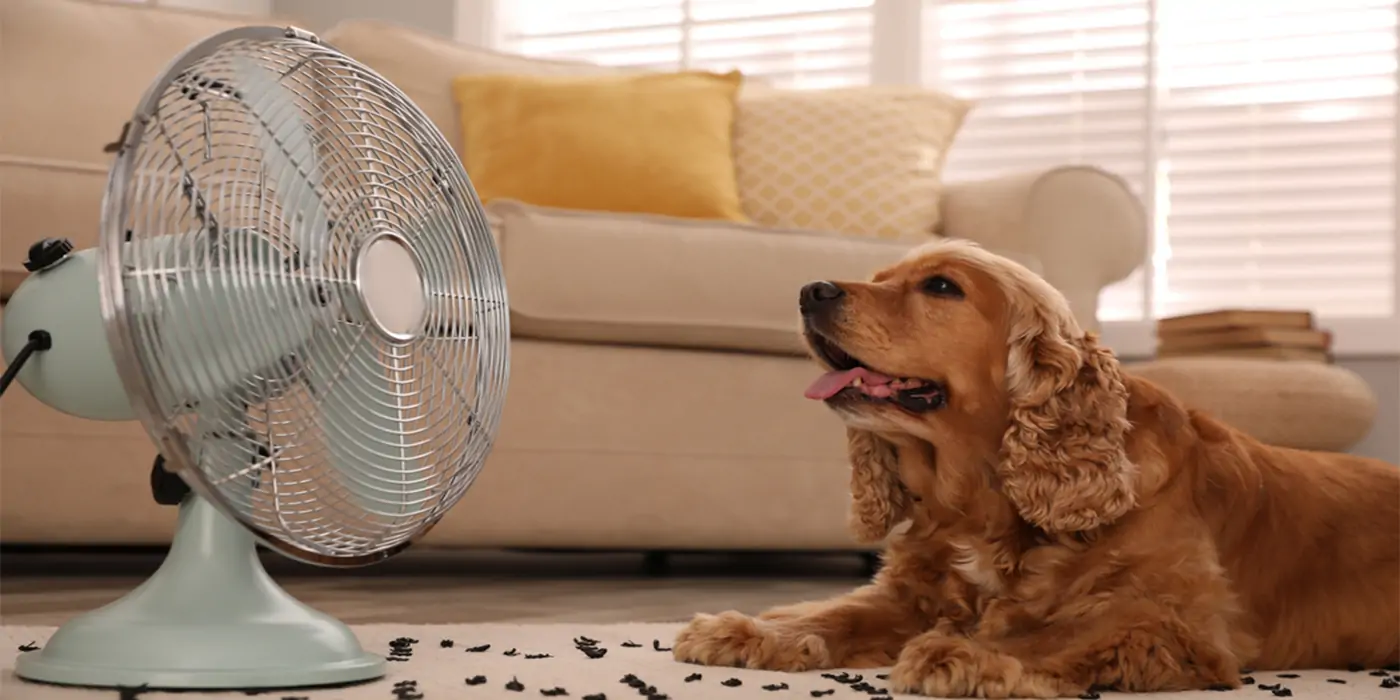
Are you looking for a new fan?Hlektragora Costas Sarris explains everything you need to know to make the right choice!
If you are looking for a “survival guide” in the heat… you are in the right place. And this is because, the fan is one of the most economical and efficient ways to cool down in the summer. There are many types. So, you will definitely find a fan to suit you. But let’s take a closer look at the categories that “play” on the market, exactly as expert identified them.
TIP! Let the fan run alongside the air conditioner for even better circulation of cool air in the house. You can also turn on the fan after turning off the air conditioner. This will help maintain the temperature that has already been set for even longer!
Floor
Due to their (usually) adjustable height… and their design with large blades, floor fans cover more square footage with their action. They have more powerful motors with variable speeds, a feature that makes them more efficient than table fans for larger spaces.
Tabletop
Thanks to their small size and lightweight construction, table fans are ideal for the home or office. They are easy to transport, and they perform best when placed a short distance from the body or face.
Wall
They are conventional fans, whose base is fixed to the wall. Because they are placed relatively high and have a larger diameter than floor fans, their action is immediately noticeable.
Ceiling
As their name suggests, they hang from the ceiling and have the ability to cool entire rooms. On their positive side… is that when the blades move in the opposite direction (clockwise), they heat the space. Specifically, in this way the device “exploits” the higher layers of air that are warmer, and then channels them downwards.
TIP! Turn on the reverse fan function, in parallel with the heating system, for even better circulation of warm air in the house.
Power: It is the most important characteristic of a fan. This is because power determines the speed of the blades. And as we know… the faster the blades move, the stronger the air currents are dispersed in the room.
Fins: An equally important feature as power is the number of fins. Reading the following example, you will understand very well why: A device with a double row of fins and less power, achieves exactly the same performance… as the device with fewer fins and more power.
Speed: Most devices have at least 3 speeds, from the softest to the most intense. However, on the market you will find fans with many more speeds, so you can adjust the airflow… exactly to your wishes.
Noise: As with all electrical appliances, here too, devices that produce less than 60dB are considered quiet. So depending on the space in which the device is intended to be placed, you must give the corresponding weight. For example, in the bedroom, you definitely need a fan that has fewer dB than a fan that is intended for use only in the living room.
Rotating head: With the oscillation function, the air “spreads” over more square meters. On the market you will mainly find models that rotate 180°… but you will also find fans that rotate up to 360°.
Head tilt: On some fans, you can even adjust the head tilt. Bring it a little higher, or a little lower… to adjust the airflow, right up to you!
Safety features: To feel completely safe around your fan, choose one that has overheating protection and a protective mesh on the blades.
Remote control: If the device comes with a remote control, then you can make all the necessary settings remotely.
Timer : If the fan has a timer, you can choose its operating hours. On some, you can also choose a delayed start.
“Smart” use : The fan can be connected to Wi-Fi, so you can control it from the comfort of your smartphone or tablet. So, wherever you are, you can make the settings you want with just a few “clicks”.
Misting : A misting fan releases pressurized water (steam) along with the air. This results in even stronger cooling in the room.

A general rule of thumb is: The larger your space… the larger and more powerful your fan needs to be. Of course, it’s also a good idea to consider the intended use of the device. But let’s be more specific. Hlektragora Costas Sarris identified various everyday scenarios… and found the right device for each of them!
Scenario #01
So let’s say you’re interested in a device that you want to use while you work. In this case, you can look for a desk fan that you can attach to your desk surface, “working” alongside you. When you go to school, take it with you… and home.
Scenario #02
Are you looking for a device that will effectively cool your large living room? You can look for a floor fan. It is a compact and powerful device that effectively covers many square meters. So, even if you have placed it far away from you, the cool air currents produced by the fan… will definitely find you. Not to mention that it is relatively light, so that when you go to sleep, you can easily carry it to the bedroom with you.
Scenario #03
Do you want to “boost” the heating or air conditioning of the room, with a device that works in parallel – or independently – with the rest of the heating/cooling systems of the house? Check for a ceiling fan. This device can be placed in any bedroom or living room. And in addition to offering its warm/cool “services”, it also upgrades the aesthetics of the space. The only limitation is that the room height needs to be at least 2.1-2.4m.
Scenario #04
In the summer, do you usually sit… outside on the porch, the terrace, the garden? It’s a shame to “run away”! A wall fan is an excellent choice to cool down. It is used both inside and outside the home, while its installation is permanent on the wall. For this reason, focus a lot of attention on the height and position you choose to place it.
Now, you know exactly how to find the ideal fan that will meet your needs this summer!